
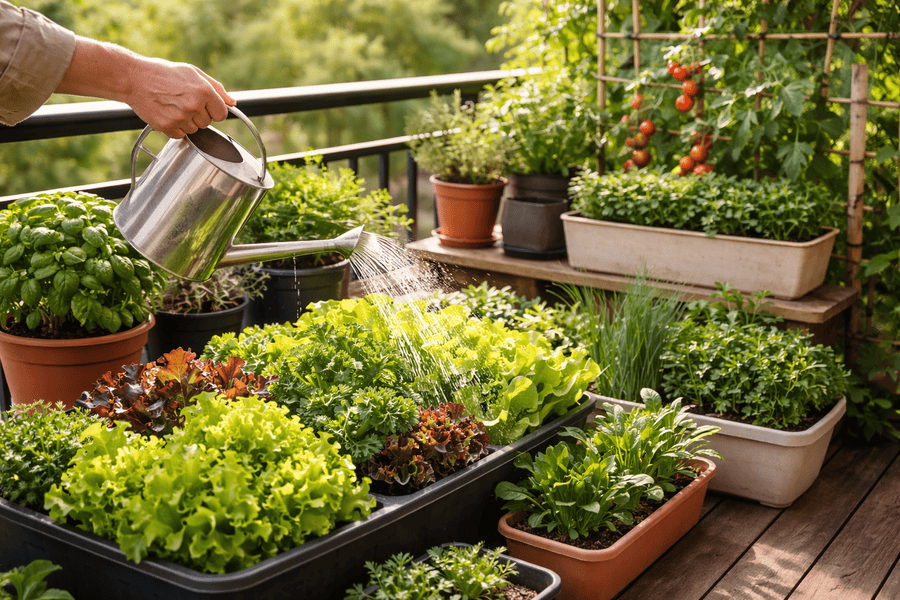
Watering sounds simple until you try growing food in a small space. A few containers on a balcony, a tiny patio setup, or a compact garden bed can swing from “soaked” to “bone dry” fast—and plants don’t love mood swings.
The good news: you don’t need a fancy system or a strict schedule. You just need a few practical habits and watering tips for small and compact gardens that keep moisture steady so your plants can grow faster, taste better, and produce longer.
If you’re building out your full small-space setup, start with the category pillar here: Small Space Gardening: Easy Wins for Beginners.
And if you’ve already been working on harvest goals, watering is the “yield protector” that makes everything else work. This pairs perfectly with: Maximize Yield in Tiny and Compact Gardens.
📦 What You’ll Learn
- ✅ How often small gardens really need watering (without guessing)
- ✅ The difference between under-watering and over-watering symptoms
- ✅ The best time of day to water compact spaces
- ✅ How to water deeply so roots grow strong
- ✅ Simple ways to keep soil evenly moist longer
💧 Why Watering Is Different in Small and Compact Gardens
In a bigger yard, the ground holds moisture and forgives mistakes. In small gardens, the soil volume is limited—so moisture swings happen faster. That’s why small-space gardeners often deal with:
- 🔥 Faster drying (containers heat up and evaporate quicker)
- 🌬️ Wind burn (balconies and patios can dry plants out fast)
- 🚿 “Flood then drought” cycles (too much at once, then nothing for days)
- 🥬 Bitter greens + slow growth (stress shows up in flavor and yield)
- 🌸 Flower drop on fruiting plants (stress = fewer tomatoes/peppers)
So the goal isn’t perfect watering. The goal is steady moisture—the kind that keeps roots growing and plants productive.
🌱 How Water Moves in Small Gardens (So You Stop Guessing)
Understanding how water behaves in compact spaces makes everything easier.
🪴 Containers (most common small-space setup)
- 💨 Dry faster because there’s less soil and more airflow around the pot
- 🌡️ Heat up faster (warm pots = faster evaporation)
- 🚿 Can drain too quickly if the soil is very light or the pot is small
- 🧽 Can stay soggy if drainage is poor or the soil is too dense
🧱 Raised beds (small footprint, but more forgiving)
- 🌿 Hold moisture longer than containers
- 💧 Still dry faster than in-ground beds in hot weather
- 🌬️ Edges dry first (outer soil loses moisture quicker)
🌿 Tiny in-ground plots (most stable moisture)
- ✅ More natural moisture buffering
- ✅ Less frequent watering in mild weather
- ⚠️ Still dries fast if shallow soil or heavy wind/sun exposure
Translation: containers usually need the most attention. Beds are more forgiving. But all small spaces punish inconsistency.
⏱️ How Often Should You Water a Small or Compact Garden?
Here’s the truth nobody loves hearing: there is no universal watering schedule that works every week of the season.
But there is a reliable approach: water based on soil moisture + plant need, not the calendar.
✅ A practical baseline (then adjust)
- ☀️ Hot weather: containers often need water daily (sometimes twice during extreme heat)
- 🌤️ Mild weather: containers often need water every 1–2 days
- 🌧️ Cool/rainy periods: you may water much less (sometimes not at all for a few days)
- 🧱 Small raised beds: often every 2–4 days depending on sun and mulch
Even within the same space, watering frequency changes based on:
- 🌱 Plant size (seedlings need moisture near the surface; big plants drink more overall)
- 🪴 Container size (small pots dry out much faster than large ones)
- ☀️ Sun exposure (more sun = faster drying)
- 🌬️ Wind (wind is basically a blow dryer for soil)
If your space is very compact and you’re trying to grow “a lot,” it’s easy to overdo the number of containers. If you haven’t already, this helps you set realistic capacity: How Many Plants Can You Grow in a Small Space?.
🕒 Best Time of Day to Water Small Gardens
In small spaces, timing matters because pots heat up and dry out quickly. A small shift in routine can save you water and reduce plant stress.
🌅 Morning (best choice most days)
- ✅ Plants absorb moisture before the heat of the day
- ✅ Leaves dry quickly, which reduces disease risk
- ✅ Soil stays more stable through the afternoon
🌞 Midday (okay only in specific situations)
- ⚠️ More evaporation = less efficient watering
- ✅ Fine for emergency watering during heat waves
- ✅ If plants are wilting hard and not recovering, water them
🌙 Evening (sometimes okay, but be careful)
- ✅ Useful when mornings aren’t possible
- ⚠️ In humid conditions, wet leaves overnight can invite issues
- ✅ Focus water at the soil line (avoid soaking foliage)
Quick rule: if you can water in the morning, do it. If you can’t, water when your plants need it—just aim at the soil, not the leaves.
Next (Part 2): You’ll learn how to water deeply (not just “wet the top”), how to check moisture fast, and the clearest signs you’re under-watering vs over-watering—especially in containers.
🚿 Deep Watering vs Light Watering (This Is Where Most People Lose Yield)
In small gardens, the biggest watering mistake is giving plants a little splash on top and calling it good. That looks helpful, but it often leads to shallow roots—and shallow roots mean plants struggle the moment the weather gets warm.
✅ What deep watering actually means
- 💧 Water slowly enough that the soil absorbs it (instead of it running out the bottom immediately)
- 🧽 Moisture reaches deeper where roots should be growing
- ⏳ You wait a minute and water again if the soil was very dry
A practical way to do this in containers:
- 🚿 Water until you see some drainage
- ⏱️ Wait 30–60 seconds
- 🚿 Water again briefly (especially if soil was dry and compacted)
That second pass is the secret sauce. Dry soil can repel water at first, so the first watering “opens the door,” and the second watering actually hydrates the root zone.
🧠 How to Check Moisture (Without Fancy Tools)
You don’t need gadgets. You just need a quick check that tells you what’s happening below the surface.
✋ The finger test (simple and reliable)
- 👉 Stick your finger 1–2 inches into the soil
- ✅ If it feels dry at that depth, it’s time to water
- ⚠️ If it feels damp, wait and check again later
For deeper containers, checking only the top can fool you. The surface can look dry while deeper soil is still wet—or the surface can look damp while deeper layers are dry.
🏋️ The “lift test” for containers
- 🪴 Lift the pot right after watering (notice the weight)
- 🪴 Lift again before watering next time
- ✅ Light pot = likely dry, heavy pot = still holding moisture
Once you learn the weight difference, this becomes a fast, low-effort routine.
👀 Visual soil cues (quick backups)
- 🌫️ Soil pulling away from the pot edges often means it’s very dry
- 🧱 Crusting on top can mean repeated shallow watering
- 🟤 Very dark, always-wet soil may mean over-watering or poor drainage
🚨 Signs You’re Under-Watering (Very Common in Small Spaces)
Under-watering doesn’t always look like “dry soil and sad leaves.” In compact gardens, plants can look fine one day and stressed the next because moisture drops quickly.
- 🥀 Midday wilting that doesn’t recover by evening
- 🥬 Bitter greens or tough leaves
- 🌱 Slow growth even when light is decent
- 🌸 Flowers dropping before fruit forms (tomatoes/peppers)
- 🍅 Small fruit that stops sizing up
If plants wilt during peak heat but bounce back later, that can be normal on very hot days. But if they don’t rebound, that’s a “water now” signal.
⚠️ Signs You’re Over-Watering (Also Common)
Over-watering is sneaky because the symptoms can look like under-watering—especially leaf yellowing and drooping. The difference is what the soil feels like and how long it stays wet.
- 🍂 Yellow leaves paired with slow growth
- 🧽 Soil that stays wet for days
- 😵 Droopy leaves even when soil is damp
- 🤢 A sour or “swampy” smell near the soil
- 🪴 Fungus gnats showing up consistently (often a soggy-soil sign)
Why this matters for yield: soggy soil can reduce oxygen around roots. Roots under stress don’t feed plants well, and that reduces production.
If you’ve battled these issues before, this support post can help you spot the bigger pattern: Small Space Gardening Mistakes.
🪴 Container vs Bed Watering (What Changes)
Small spaces often mix containers and beds. Watering needs are different, so it helps to treat them like separate “zones.”
🪴 Containers
- 💨 Dry out faster
- 🚿 Need slower, deeper watering
- 🧽 Benefit from consistent moisture (less swing)
- ⚠️ Small pots can dry out within a day in warm weather
🧱 Raised beds / small in-ground plots
- ✅ Hold moisture longer than containers
- ✅ More forgiving if you miss a day
- 🌬️ Edges dry first, so check border zones
If you grow both, don’t force one schedule. You’ll end up over-watering beds or under-watering containers.
Next (Part 3): You’ll get simple methods to keep soil moist longer, how to adjust watering for heat/cool seasons, quick fixes when yields are low, plus FAQs and matching FAQ schema.
🌿 Simple Ways to Keep Soil Moist Longer (Without Getting Complicated)
In small gardens, the “moisture swing” is the enemy. Your goal is to slow evaporation and keep soil evenly damp—not constantly wet, just stable.
🪵 1) Mulch is your best friend
A thin mulch layer helps hold moisture, reduces heat stress, and keeps the soil surface from crusting.
- 🌾 Helps soil stay moist longer
- ☀️ Keeps roots cooler
- 💧 Reduces how often you need to water
🪴 2) Use the right container size (small pots = constant watering)
If you’re watering nonstop, your pot might simply be too small for the plant. Bigger soil volume buffers moisture better.
- ✅ Larger pots dry slower
- ✅ Roots have room to spread and drink evenly
- ⚠️ Tiny pots can turn into daily (or twice daily) watering in warm weather
🧽 3) Improve water absorption (dry soil can repel water)
If water runs straight through the pot, slow down and water in two passes.
- 🚿 Water once until you see a little drainage
- ⏱️ Wait 30–60 seconds
- 🚿 Water again so the root zone actually hydrates
🌬️ 4) Protect plants from wind stress (wind dries soil fast)
Balconies can be surprisingly windy. Wind doesn’t just dry leaves—it dries soil and pulls moisture out of plants faster.
- ✅ Check moisture more often on windy days
- ✅ Water earlier when wind is expected
- ✅ Use mulch to reduce surface drying
🌦️ Adjust Watering for Weather and Seasons
Small gardens don’t need “a schedule.” They need a simple adjustment plan.
🔥 Heat waves
- 💧 Check containers daily (sometimes morning + late afternoon)
- 🌅 Water early so plants go into the heat hydrated
- 🪵 Mulch to protect roots and reduce evaporation
🌤️ Mild weeks
- ✅ Water based on the moisture test
- ✅ Deep water less often instead of shallow water daily
🌧️ Rainy periods
- ⚠️ Don’t assume pots are watered evenly—rain may miss parts of the soil
- ✅ Check soil depth with the finger test
- ✅ Pause watering if soil is staying damp
Season shifts tie naturally into your future support post Seasonal Planning for Small Space Gardens, because planting and watering rhythms go together.
🧯 Quick Watering Fixes When Yields Are Low
If your plants look “fine” but aren’t producing much, water stress is often a hidden cause—especially in containers.
🍅 Problem: Flowers drop and fruit isn’t setting
- ✅ Aim for steady moisture (avoid dry-to-soaked swings)
- ✅ Water in the morning consistently
- ✅ Deep water so roots can stabilize the plant
🥬 Problem: Greens taste bitter or bolt early
- ✅ Check moisture more often (greens hate drought stress)
- ✅ Mulch the surface to reduce swings
- ✅ Harvest often and keep the plant growing steadily
🌱 Problem: Growth is slow even with decent light
- ✅ Switch to deep watering (not surface watering)
- ✅ Check that soil isn’t staying soggy (roots need oxygen too)
- ✅ Consider pot size—tiny pots restrict roots and water stability
If your goal is bigger harvests overall, link back to the yield strategy post here: Maximize Yield in Tiny and Compact Gardens.
🔗 Helpful Internal Links (Use Near the End)
- 🔗 Start here: Small Space Gardening: Easy Wins for Beginners
- 🔗 Yield strategy: Maximize Yield in Tiny and Compact Gardens
- 🔗 Light help: Maximize Light in Small Gardening Spaces: Simple Tricks
- 🔗 Capacity planning: How Many Plants Can You Grow in a Small Space?
- 🔗 Common pitfalls: Small Space Gardening Mistakes
🏁 Conclusion: Consistent Watering Beats Perfect Watering
In small and compact gardens, watering doesn’t have to be complicated—but it does need to be consistent. When you keep moisture steady, plants grow faster, greens taste better, and fruiting crops set more reliably.
If you want a simple routine that works: check moisture, water deeply when needed, and protect the soil surface so it doesn’t swing from soaked to bone dry. You’ll get better results without babysitting your garden.
And if you’re chasing bigger harvests, watering is the habit that protects every other strategy. Keep this post bookmarked and pair it with: Maximize Yield in Tiny and Compact Gardens.
❓ Watering Tips for Small and Compact Gardens FAQs
How often should I water a small garden?
Water based on soil moisture, not a rigid schedule. In hot weather, containers may need daily watering, while mild weeks often require watering every 1–2 days. Raised beds and in-ground plots usually need less frequent watering.
Do small gardens need more water than large gardens?
Small gardens often need water more frequently because they have less soil volume and dry out faster, especially in containers. The total water used may not be higher, but the timing matters more.
Why do my plants wilt even though I water regularly?
Wilting can happen if watering is too shallow, the root zone isn’t actually getting hydrated, or heat and wind are pulling moisture out faster than roots can absorb it. Deep watering and checking soil moisture below the surface usually fixes this.
Is it better to water deeply or lightly in small spaces?
Deep watering is usually better. It encourages stronger roots and steadier growth. Light surface watering often leads to shallow roots and stress during warm weather.
Can over-watering reduce yields?
Yes. Over-watering can reduce oxygen around roots and slow growth, which lowers production. If soil stays soggy for days, reduce watering and check that containers drain properly.

👋 About the Author
Steve is the creator of Indoor Gardening Essentials and a hands‑on indoor gardener with years of experience growing plants in small apartments, tight corners, and low‑light spaces.
He specializes in practical, beginner‑friendly setups—from kitchen herbs and windowsill succulents to self‑watering planters, terrariums, and simple hydroponic systems. Everything he teaches comes from real experimentation, not guesswork.
Steve documents his projects, successes, and occasional failures on his YouTube channel Small Farms Big Ideas , where he tests grow lights, soil mixes, watering routines, and small‑space gardening methods.
His goal is simple: help new indoor gardeners build confidence, avoid common mistakes, and grow healthy plants—no matter how small their space is.