
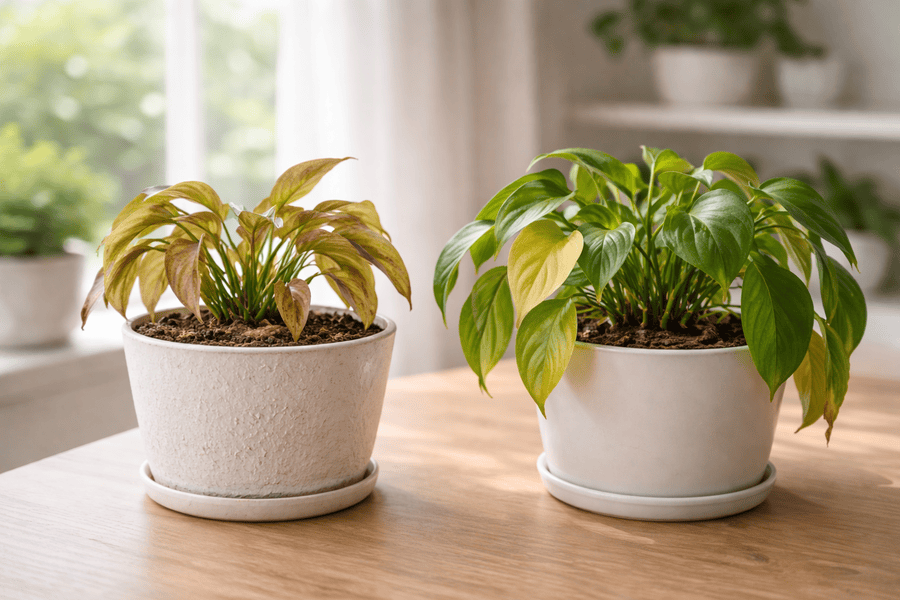
If you’ve ever stared at a droopy plant and thought, “Is it thirsty… or am I drowning it?” you’re in the club.
Underwatering vs overwatering can look shockingly similar at first—drooping leaves, yellowing, slow growth, even leaf drop.
And that’s exactly why this is one of the most common ways beginners accidentally make things worse.
Here’s the good news: you don’t need a special tool or a gardening degree to figure this out.
With a few quick checks (soil feel, pot weight, leaf texture), you can usually diagnose the problem in minutes and choose the right fix the first time.
📦 What You’ll Learn
- 🌿 The easiest signs that separate underwatering from overwatering
- 💧 Simple soil checks that settle the question fast
- 🍃 Leaf texture clues beginners often miss
- 🪴 How pots, drainage, light, and seasons tilt the odds
- 🚑 Exactly what to do once you know which one it is
🤔 Why Underwatering and Overwatering Look So Similar
Both problems stress the roots, and stressed roots can’t support healthy leaves. That’s why you see overlap: drooping, yellowing, leaf drop, and stalled growth.
The difference is what’s happening underground:
- 💧 Overwatering keeps soil wet too long, cutting off oxygen. Roots “suffocate.”
- 🏜️ Underwatering dries soil too much, so roots can’t pull up water. Roots “dehydrate.”
And here’s the classic beginner trap: a plant droops, so you water. If it was overwatered, you just made it worse. If it was underwatered, you fixed it. So we diagnose first.
🕵️ The 60-Second Diagnosis Test (Do This First)
If you do nothing else, do these quick checks in order. They solve most cases immediately.
🖐️ 1) Finger test (quick and reliable)
- Stick your finger 1–2 inches into the soil.
- If it’s wet or very damp, hold off watering.
- If it’s dry at that depth, watering may be needed.
Tip: For larger pots, check deeper. The top inch can be dry while the bottom is soaking wet.
⚖️ 2) Pot weight test (surprisingly accurate)
- A freshly watered pot feels heavy.
- A dry pot feels noticeably lighter.
If you get used to this, you’ll be able to “read” your plant without guessing.
🕳️ 3) Drainage check (this changes everything)
- Does the pot have a drainage hole?
- Is it blocked by compacted soil or a stuck saucer?
- Is there standing water in the saucer or cachepot?
Many “overwatering” issues are really “no drainage” issues.
⚖️ Underwatering vs Overwatering: The Big Picture
Before we get into the detailed signs, here’s the simple framework:
- 💧 Overwatering: Soil stays wet → roots lack oxygen → leaves droop/yellow/soft → growth slows.
- 🏜️ Underwatering: Soil stays dry → roots can’t pull water → leaves droop/curl/crisp → plant perks up after watering.
Now let’s talk about what you’ll actually see.
🍃 Leaf Clues That Separate the Two
Leaves are basically your plant’s “status report.” Color helps, but texture is often the best clue.
💧 Signs your plant is overwatered
- 🟡 Yellow leaves that feel soft or limp
- 🥀 Drooping even though the soil is wet
- 🍃 Leaves may look swollen or “puffy” in some plants
- 🍂 Leaves drop easily with a gentle tug
- 🐌 Growth slows down or stops
🏜️ Signs your plant is underwatered
- 🍂 Leaves feel thin, papery, or crisp
- ↩️ Leaves curl inward or droop with dry texture
- 🟤 Brown edges/tips are common
- 🌿 Plant perks up within hours after a thorough watering (many plants do)
Quick rule: Soft + wet soil = suspect overwatering. Crispy + dry soil = suspect underwatering.
Indoor Plant Troubleshooting Guides
🟡 Yellow Leaves: Same Color, Different Meaning
Yellow leaves can show up in both situations, which is why this is confusing.
- 💧 Overwatering yellow: often soft, limp, sometimes spreading quickly, often starts on lower leaves.
- 🏜️ Underwatering yellow: can look dull or pale, often paired with crispy edges and very dry soil.
If yellowing is your main symptom, it helps to read it alongside soil moisture.
🥀 Drooping: Wet Wilt vs Dry Wilt
Drooping is the #1 symptom that causes misdiagnosis. Let’s translate it.
💧 Wet wilt (overwatering-style droop)
- Soil feels wet or damp
- Leaves droop and may feel limp
- Sometimes yellowing shows up at the same time
- Watering again usually makes it worse
🏜️ Dry wilt (underwatering-style droop)
- Soil feels dry at depth
- Leaves droop and may feel thinner
- Edges may crisp
- Plant often improves after a thorough watering
If you’re unsure: do not water on emotion. Check the soil first.
🪴 Soil Clues That Settle the Question
The soil tells the real story—especially if you look beyond the surface.
💧 Overwatered soil usually looks like
- Heavy, dense, and wet for days
- May smell musty or sour
- Can grow fuzzy mold on top (not always, but it happens)
🏜️ Underwatered soil usually looks like
- Bone dry below the surface
- Pulling away from the pot edges
- Water runs through quickly at first (the soil repels water when too dry)
That last one matters: if water shoots out the bottom immediately, your soil may be so dry it can’t absorb evenly. That’s when bottom watering is helpful (we’ll cover it below).
🦟 Fungus Gnats vs Bone-Dry Soil
Fungus gnats are basically a neon sign that says, “This soil stays moist.” Their larvae thrive in damp potting mix.
- 💧 If you have fungus gnats, the plant is very likely being kept too wet (or the top stays consistently moist).
- 🏜️ Underwatered plants rarely have gnats because the larvae can’t survive in dry soil.
Gnats don’t always mean your plant is doomed, but they’re a strong clue that drying time needs improvement.
🪟 Environmental Factors That Tip the Scale
Sometimes it’s not just your watering habits—your environment changes how quickly soil dries.
🌥️ Low light increases overwatering risk
- Plants use less water in dim light
- Soil dries slower
- Beginners often water “because it’s been a week”
☀️ Bright light increases underwatering risk
- Plants use more water in brighter windows
- Soil dries faster
- Smaller pots can dry out quickly
❄️ Seasons matter (winter changes everything)
- Lower light + cooler temps = soil dries slower
- Many indoor plants grow slower in winter
- Overwatering is extra common during this season
Indoor Plant Lighting Guides
🪴 Pots, Drainage, and Soil: The Real Cause for Many “Watering” Problems
Two people can water the same amount and get totally different results depending on the pot and the mix.
🕳️ Drainage holes (your safety net)
- Pots with drainage let excess water escape
- Pots without drainage trap water and create soggy zones
- Decorative cachepots are fine if a nursery pot sits inside and you empty excess water
📏 Pot size matters
- Oversized pots hold more soil
- More soil holds more water
- Small plants in big pots are easier to overwater
🧱 Soil mix matters
- Dense soil stays wet longer (higher overwatering risk)
- A light, airy mix dries more evenly
When you “fix watering,” you’re often really fixing drainage, pot choice, and soil structure.
Containers & Soil Guides
🚑 What To Do Once You Know the Problem
💧 If you’re overwatering
- 🛑 Stop watering until the soil dries appropriately
- 🧺 Empty saucers and cachepots so the pot isn’t re-soaking water
- 🌬️ Improve airflow (a small fan across the room helps)
- ☀️ Move to brighter indirect light to help the plant use water
- 🪴 Check drainage holes and unblock them if needed
Repotting decision: If the soil smells bad, stays soggy, or you suspect root rot, repotting into fresh, well-draining mix can help. If the plant is only slightly overwatered and drainage is good, drying out is often enough.
🏜️ If you’re underwatering
- 💧 Water thoroughly until it drains from the bottom
- 🪣 If soil is very dry and water runs through, bottom-water soak for 20–30 minutes, then drain
- 📅 Reset your routine: check soil first instead of watering on a schedule
- 🪴 Consider a slightly larger pot only if the plant is severely root-bound (don’t jump sizes)
Tip: After a deep rehydration, let the plant recover. Don’t “catch up” with extra watering.
✂️ Should You Remove Damaged Leaves?
Damaged leaves won’t usually turn perfect again, but removing them can help with appearance and airflow. The goal is balance: don’t strip the plant bare, and don’t leave mushy leaves that attract pests.
- ✂️ Remove leaves that are mostly yellow, brown, mushy, or falling off
- 🧤 Use clean scissors (wipe with rubbing alcohol)
- 🌿 Keep enough healthy leaves for photosynthesis and recovery
🧠 How to Prevent Both Problems Long-Term
Here’s the simple routine that saves the most plants:
- 🖐️ Check the soil before watering (every time)
- 🕳️ Use pots with drainage holes
- 🪴 Match pot size to plant size
- ☀️ Match plant choice to your light (or supplement with a grow light)
- 🔄 Expect seasonal changes: water less in lower light periods
You don’t need a perfect schedule. You need a consistent check-first habit.
Beginner Indoor Gardening Guides
✅ Quick Cheat Sheet
- Wet soil + drooping → likely overwatering (wet wilt)
- Dry soil + drooping → likely underwatering (dry wilt)
- Yellow + soft → often overwatering
- Yellow + crispy edges → often underwatering
- Gnats hovering near soil → often too much moisture
🌿 Conclusion
Underwatering and overwatering can look similar, but your soil and leaf texture usually tell the truth fast.
Check the soil at depth, feel the pot weight, and confirm drainage before reacting.
Once you apply the right fix, most plants recover surprisingly well—especially if you catch the issue early.
And if you’ve been guessing? Don’t feel bad. Almost every plant person has done the “water it again” mistake at least once. The difference now is you know how to check first.
Continue Exploring Indoor Gardening
FAQs
How can I tell if my plant is underwatered or overwatered?
Start with soil moisture at depth. Wet soil paired with drooping or soft yellowing leaves often points to overwatering. Dry soil paired with thin or crispy leaves often points to underwatering. Pot weight and drainage holes also help confirm.
Can a plant be both underwatered and overwatered?
Yes. This happens when soil swings between extreme dryness and heavy watering. Very dry soil can repel water, so water runs through without soaking evenly, leaving parts of the root ball dry while other parts stay wet. A steadier check-first routine helps prevent this cycle.
Why does my plant droop even though the soil is wet?
This is often “wet wilt.” When roots stay wet too long, they can’t access oxygen properly and struggle to function. Leaves droop as a stress response, even though there’s water in the pot. The fix is usually letting the soil dry and improving drainage and airflow.
Should I water on a schedule to avoid mistakes?
Schedules are unreliable indoors because light, temperature, humidity, pot size, and plant type change how quickly soil dries. A better approach is checking moisture before watering so you water based on need, not the calendar.
How long does it take a plant to recover once I fix watering?
It depends on how stressed the roots are and the plant type. Mild issues can improve in a few days, while more serious root stress can take a couple weeks. The best sign of recovery is healthy new growth and no new yellowing or drooping.
📚 References & Further Reading
- University of Maryland Extension – Yellowing Leaves on Indoor Plants
Explains the most common reasons houseplant leaves turn yellow, with a strong focus on watering stress and environmental factors.
https://extension.umd.edu/resource/yellowing-leaves-indoor-plants
- University of Maryland Extension – Overwatered Indoor Plants
Covers how excess water affects roots and foliage, including classic yellowing symptoms and prevention tips.
https://extension.umd.edu/resource/overwatered-indoor-plants
- Iowa State University Extension – Causes of Yellowing and Dropping Leaves
A clear FAQ-style guide explaining why houseplant leaves turn yellow or brown and eventually drop, including light and temperature stress.
https://yardandgarden.extension.iastate.edu/faq/what-causes-leaves-my-houseplant-turn-yellow-or-brown-and-drop
- University of Maine Cooperative Extension – Tips for Growing Houseplants
Discusses general indoor plant care, including how light, watering, and humidity affect leaf color and overall plant health.
https://extension.umaine.edu/publications/2612e/
- Penn State Extension – Preventing, Diagnosing, and Correcting Common Houseplant Problems
An in-depth overview of common indoor plant issues, including yellowing leaves, with diagnostic tips for beginners.
https://extension.psu.edu/preventing-diagnosing-and-correcting-common-houseplant-problems

👋 About the Author
Steve is the creator of Indoor Gardening Essentials and a hands‑on indoor gardener with years of experience growing plants in small apartments, tight corners, and low‑light spaces.
He specializes in practical, beginner‑friendly setups—from kitchen herbs and windowsill succulents to self‑watering planters, terrariums, and simple hydroponic systems. Everything he teaches comes from real experimentation, not guesswork.
Steve documents his projects, successes, and occasional failures on his YouTube channel Small Farms Big Ideas , where he tests grow lights, soil mixes, watering routines, and small‑space gardening methods.
His goal is simple: help new indoor gardeners build confidence, avoid common mistakes, and grow healthy plants—no matter how small their space is.