
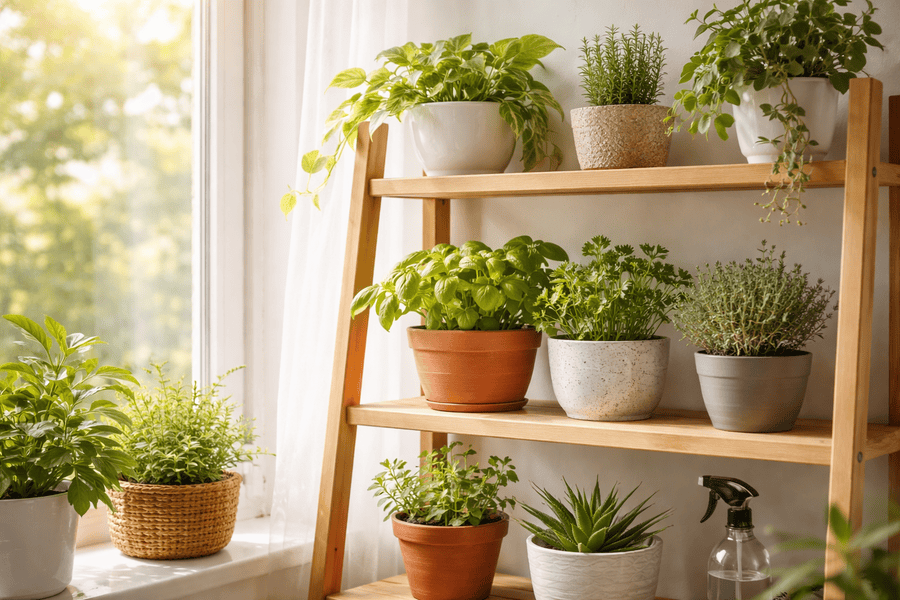
If your plants are surviving but not really thriving, there’s a solid chance light is the missing piece.
And in small homes, it’s extra tricky because you’re working with whatever windows you’ve got — plus furniture, curtains, and real-life clutter.
The good news: you can maximize light in small gardening spaces without turning your home into a greenhouse. A few small tweaks can make a big difference, especially for herbs and vegetables that want brighter conditions.
If you’re building out your small-space setup, these posts fits right into your foundation:
Small Space Gardening: Easy Wins for Beginners and
Container Gardening for Small Spaces.
📦 What You’ll Learn
- 🔍 A quick way to judge your light (no tools needed)
- 🪟 Simple window moves that instantly boost brightness
- 🪞 Easy tricks to bounce light into darker corners
- 📐 How shelves + plant height change everything
- 💡 When a grow light helps (and how to keep it simple)
🔍 Step 1: Figure Out What You’re Working With
Before you rearrange anything, take five minutes to “read” your light. You don’t need a meter — you just need a realistic snapshot of how bright your space actually is.
🪟 Use the shadow test
- If you see a sharp, crisp shadow on the floor or wall: you’ve got strong direct light.
- If the shadow is soft and blurry: you’ve got bright indirect light (still useful).
- If you barely see a shadow at all: that spot is low light, and you’ll need different plants or help from a grow light.
🧭 Quick expectations by window direction
- 🌅 East-facing: gentle morning sun (great for greens and many herbs)
- 🌇 West-facing: stronger afternoon sun (great for fruiting plants if heat isn’t extreme)
- ☀️ South-facing: usually your brightest option (prime real estate for peppers/tomatoes)
- 🌥️ North-facing: steady but low light (best for low-light plants, not veggies)
Don’t stress if your windows aren’t “perfect.” The goal isn’t perfect. The goal is better than it was yesterday.
🪟 Step 2: Use Your Window Like a Tool
Most small-space gardeners lose a ton of usable light without realizing it — usually because plants are just a little too far from the window, or the window area is blocked.
📏 Move plants closer than you think
- 🌿 For most indoor herbs and greens, closer is almost always better.
- 🪴 If a plant is more than a few feet from a window, light drops off fast (even if the room looks bright to you).
- 🧼 If leaves are touching cold glass in winter, pull them back slightly — but keep the plant as close as you safely can.
🧽 Clean the glass (seriously)
This sounds too simple, but a dirty window can cut the amount of light coming through. A quick wipe is one of the easiest “free upgrades” you can do.
🪟 Clear the light blockers
- 🪑 Move tall furniture away from the window if possible.
- 🧺 Remove clutter on the sill that blocks light from reaching plants.
- 🧵 Swap heavy curtains for lighter ones during the day (even partway open helps).
🔁 Rotate weekly
Plants lean toward light. Rotating pots once a week keeps growth more even and prevents that “one-sided” look (and weak stems).
🪞 Step 3: Bounce Light Into Darker Spots
If your space only has one decent window, bouncing light is how you stretch it further. You’re basically helping your plants “see” more light hours without changing the window itself.
- 🪞 Use a mirror: place it to reflect window light toward plants (not directly blasting them with heat).
- ⬜ Use light surfaces: white walls, light shelves, and pale tabletops reflect more light than dark furniture.
- ✨ Use a shiny tray: even a simple reflective plant tray can help brighten a shelf setup.
Tiny note: if you use a mirror, keep it stable and angled so it’s reflecting light into the room — not creating a hot “laser spot” on leaves in strong summer sun.
📐 Step 4: Fix Height and Angles (This One’s Huge)
In small spaces, height is everything. A plant that struggles on a low table might thrive on a shelf a foot higher — simply because it’s closer to the window line and not shaded by furniture.
📚 Shelf rules that work in real homes
- ⬆️ Top shelves: best for herbs, greens, and anything that wants brighter light.
- ⬇️ Lower shelves: best for lower-light plants (or decorative greenery, not veggies).
- 🧱 Don’t stack too deep: if a plant is behind another plant, it’s basically living in shade.
If you’re growing food indoors, prioritize the brightest positions for:
Best Vegetables to Grow in Small Spaces and
Best Herbs to Grow Indoors in Small Spaces.
💡 Step 5: Grow Lights (Simple, Not Overwhelming)
If your best window still isn’t enough — or your winter light drops hard — a grow light can be the difference between “meh” plants and consistent growth. The trick is keeping it simple so it doesn’t become a whole new hobby.
✅ When a grow light is actually worth it
- 🌥️ Your brightest spot still produces weak, leggy growth
- 🥬 Greens grow slowly and stretch toward the window
- 🌿 Herbs get pale or sparse even with good watering
- 🍅 Fruiting plants (like peppers) flower but don’t set fruit well
⏲️ The easiest grow-light setup
- 💡 Pick a simple LED grow light (nothing fancy required)
- ⏲️ Put it on a timer so you don’t have to remember daily
- 📏 Keep the light reasonably close above the plant canopy (not across the room)
🕒 How long should it be on?
- 🌿 Herbs + greens: often do well with a steady daily schedule
- 🍅 Fruiting plants: usually want more consistent brightness to stay sturdy and productive
You don’t need to “optimize” this to death. A consistent routine beats a perfect one that you don’t stick with.
👉Tip: I keep mine (strong 200 watt) about 2 feet away and on 12 hours and off 12 hours but if its a weaker led light you may want to go to 16 hours on and move it closer.
🌱 Step 6: Match Plants to Your Light (So You Stop Fighting It)
This is the part that saves you the most frustration: instead of trying to force a sun-loving plant to survive in low light, pick plants that fit your actual conditions.
🌥️ If your space is lower light
- 🥬 Focus on leafy greens, green onions, and forgiving herbs
- 🪴 Keep containers small-to-medium so plants aren’t “lost” in damp soil
- 💡 Consider a small grow light if you want steady growth year-round
☀️ If you’ve got a bright window
- 🌶️ Peppers and patio tomatoes become realistic
- 🌿 Basil, thyme, oregano tend to stay fuller and tastier
- 🍅 You’ll get better flowering + stronger stems
🚩 Signs Your Plants Need More Light
Plants are pretty honest. If light is low, they show it — usually in a few predictable ways.
🌿 Leggy growth (tall + floppy)
- ✅ Fix: move closer to the window or add a grow light above the plant
- ✅ Fix: rotate weekly so it doesn’t stretch one direction
- ✅ Fix: pinch/trim to encourage bushier growth (especially herbs)
🧭 Leaning toward the window
- ✅ Fix: rotate the pot
- ✅ Fix: raise the plant so light hits it more evenly
🍃 Small leaves + slow growth
- ✅ Fix: shift to a brighter position (even a small move can help)
- ✅ Fix: avoid overwatering “slow plants” — low light + wet soil is a rough combo
🌼 Flowers drop / fruit doesn’t set
- ✅ Fix: increase light first (this is usually the biggest lever)
- ✅ Fix: keep watering consistent (big swings stress fruiting plants)
🏠 Quick Room-by-Room Light Fixes
🍳 Kitchen
- 🪟 Use the brightest window for herbs you use often
- 📌 Put plants where you’ll notice them (you’ll water better automatically)
🛋️ Living room
- 📚 Raise plants on a stand or shelf near the window
- 🪞 Bounce light with a mirror or bright wall nearby
🛏️ Bedroom
- 🌥️ Stick to forgiving greens/herbs unless the window is very bright
- 💡 A small grow light can make a shelf setup work without taking space
🚿 Bathroom
- 🪟 If you have a window: herbs can work, but watch humidity + airflow
- 🌥️ No window: this is usually decorative-plant territory, not vegetables
🏙️ Balcony or patio
- ☀️ Use height: stands and shelves can reduce shading
- 💨 Wind matters: group pots so they shelter each other a bit
❓ Maximize Light in Small Gardening Spaces FAQs
How can I tell if my space has enough light for plants?
Try the shadow test during the brightest part of your day. A sharp shadow usually means strong light, a soft shadow means bright indirect light, and barely any shadow usually means low light.
How close should plants be to a window for good light?
In most homes, closer is better. Light drops quickly as you move away from windows, so placing plants right at the window or as near as practical usually improves growth.
What’s the easiest way to increase light without buying anything?
Move plants closer to the window, clean the glass, open curtains fully during the day, and raise plants onto shelves or stands so they sit higher and catch more light.
Do mirrors really help plants get more light?
They can. A mirror or reflective surface can bounce window light into a darker area, which helps in small spaces. Just avoid creating a concentrated hot spot on leaves in strong sun.
When should I use a grow light?
Use one when plants get leggy, grow slowly, or can’t stay healthy even near your brightest window. Grow lights are especially helpful in winter or in homes with limited natural light.
How many hours should a grow light be on?
A consistent daily schedule works best. Many indoor growers run lights long enough to mimic a solid daytime window, especially for herbs and greens.
Why are my plants leaning toward the window?
They’re reaching for light. Rotating pots weekly and moving plants closer to the window or to a brighter position helps prevent lopsided growth.
What vegetables handle lower light better?
Leafy greens and many herbs tolerate lower light better than fruiting plants. Peppers and tomatoes usually need stronger, more consistent light to produce well.
🌼 Conclusion
If you want better growth in a small space, light is the lever that changes everything. The best part is you don’t need to do ten things at once — just pick one or two simple tweaks and try them this week.
- ✅ Move plants closer to the window
- ✅ Raise them higher (stands and shelves help a lot)
- ✅ Bounce light with bright surfaces
- ✅ Add a simple grow light if your home is truly dim
And if you want the bigger roadmap for building a small-space garden that actually works long-term, jump back here:
Small Space Gardening: Easy Wins for Beginners.
Next, pair this with:
Best Vegetables to Grow in Small Spaces and
Best Herbs to Grow Indoors in Small Spaces.
📚 References & Further Reading
University of Minnesota Extension — Lighting Indoor Plants
University of Maryland Extension — Lighting Indoor Plants
University of Illinois Extension — Houseplants: Lighting

👋 About the Author
Steve is the creator of Indoor Gardening Essentials and a hands‑on indoor gardener with years of experience growing plants in small apartments, tight corners, and low‑light spaces.
He specializes in practical, beginner‑friendly setups—from kitchen herbs and windowsill succulents to self‑watering planters, terrariums, and simple hydroponic systems. Everything he teaches comes from real experimentation, not guesswork.
Steve documents his projects, successes, and occasional failures on his YouTube channel Small Farms Big Ideas , where he tests grow lights, soil mixes, watering routines, and small‑space gardening methods.
His goal is simple: help new indoor gardeners build confidence, avoid common mistakes, and grow healthy plants—no matter how small their space is.