
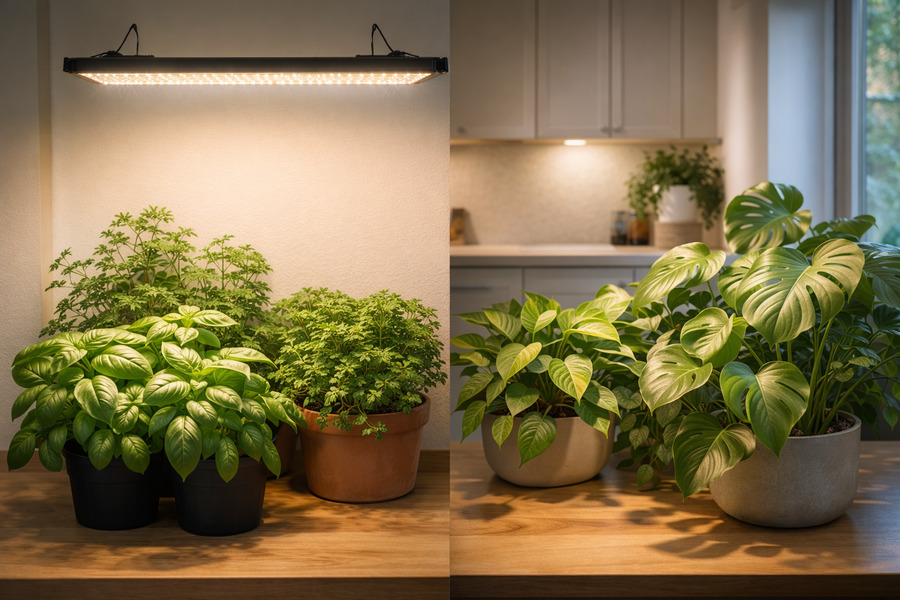
Lighting for herbs vs houseplants is one of the most common points of confusion for beginner indoor growers. Both live indoors, both sit near windows or under grow lights — yet one often thrives while the other struggles.
The reason comes down to what the plant is trying to do. Herbs are grown for active growth and harvest, while most houseplants are grown for steady foliage and long-term health. Those goals require very different lighting approaches.
Once you understand why herbs usually need more light than houseplants, it becomes much easier to set realistic expectations and avoid common lighting mistakes.
🌿 What You’ll Learn
- 🌱 Why herbs almost always need more light than houseplants
- 💡 How growth goals affect lighting needs
- 📏 Why placement matters differently for herbs vs foliage plants
- ⏰ How light hours typically differ between the two
- ⚠️ What goes wrong when both are treated the same
🌞 Why Herbs and Houseplants Have Different Light Needs
At first glance, herbs and houseplants seem similar — they’re all green, leafy, and grown indoors. But biologically, they’re built for very different environments.
Most culinary herbs evolved in open, sunny conditions. Many popular houseplants evolved under tree canopies or in filtered forest light. That difference shows up immediately when you grow them indoors.
🎯 Growth goals: harvest vs display
Herbs are grown to produce usable leaves. That means they’re expected to grow quickly, replace harvested growth, and stay compact at the same time.
Houseplants, on the other hand, are usually grown for appearance. Slow, steady growth with healthy leaves is ideal — rapid growth isn’t necessary.
Because of this, herbs typically require brighter and more consistent light to fuel ongoing growth.
🌱 Why herbs evolved for brighter conditions
Many common herbs originate from regions with long days and strong sunlight. Indoors, window light alone often isn’t enough to meet those needs, especially during fall and winter.
When herbs don’t get enough light, they stretch, grow leggy, and produce weaker flavor. This is often mistaken for a watering or fertilizer issue, when it’s really a lighting limitation.
If you’ve seen this before, it ties closely to why indoor plants grow slowly (it’s usually light).
🌿 Typical Light Needs for Indoor Herbs
Indoor herbs generally need brighter light and longer daily exposure than most houseplants. This doesn’t mean harsh or damaging light — but it does mean stronger, more intentional setups.
💡 Why herbs need stronger, longer light
Herbs are constantly producing new growth. Each harvest removes leaves, and the plant must replace them. Without enough light, that process slows or stops.
This is why herbs often perform best under grow lights placed close enough to deliver usable light for most of the day. Understanding
how many hours of light indoor plants need helps set realistic schedules for herbs.
📉 What happens when herbs don’t get enough light
When light is insufficient, herbs may:
- 🌿 Grow tall and thin instead of bushy
- 🍃 Produce smaller, weaker leaves
- 😕 Lose flavor and aroma
These symptoms often appear even when houseplants nearby look perfectly fine — a clear sign that herbs and houseplants should not always be lit the same way.
In the next section, we’ll look at typical light needs for common houseplants, and why giving them “herb-level” lighting can sometimes cause problems.
🪴 Typical Light Needs for Common Houseplants
Most houseplants are far more tolerant of moderate or indirect light than herbs. While they still need consistent light to stay healthy, their growth goals are very different.
Houseplants are not grown for harvest. Instead, they’re expected to maintain healthy foliage over long periods, often in environments with filtered or shifting light.
🌤️ Indirect light preferences
Many popular houseplants evolved under tree canopies or in shaded forest environments. Indoors, they often perform best with bright but indirect light rather than intense, direct exposure.
Under grow lights, this usually means lights placed a bit farther away or run for fewer hours than what herbs require.
⚠️ Why too much light can stress houseplants
When houseplants are given herb-level lighting — strong light placed close for long hours — they can become stressed instead of thriving.
Signs of excess light include faded leaves, stalled growth, or stress that looks like watering problems. This overlap is explained further in
can indoor plants get too much light.
⚖️ Can Herbs and Houseplants Share the Same Grow Light?
In some cases, yes — but it requires careful placement. The main challenge is that herbs and houseplants usually need different light intensities.
✅ When sharing a grow light works
Sharing a light can work when:
- 🌱 Herbs are placed closer to the light
- 🪴 Houseplants sit slightly farther away
- 📏 Distance is adjusted instead of hours
This approach allows both plant types to receive appropriate light without running separate schedules.
❌ When sharing causes problems
Problems arise when all plants sit at the same height under one light. In that case, either the herbs don’t get enough light or the houseplants get too much.
Trying to fix this by increasing hours often makes things worse. This is a common issue covered in common indoor plant lighting mistakes.
📏 Placement Differences Between Herbs and Houseplants
Placement matters more than most people realize when lighting mixed plant types.
⬇️ Herbs prefer centered, overhead light
Herbs respond best to direct, overhead light that hits the entire canopy evenly. This encourages compact growth and consistent leaf production.
If placement is off, herbs will stretch toward the light quickly — a sign that the setup needs adjustment. Reviewing grow light placement for indoor plants can help fine-tune mixed setups.
↔️ Houseplants tolerate wider placement
Houseplants are usually more forgiving. Slightly angled or indirect placement often works fine as long as total light exposure stays within their comfort zone.
In the final section, we’ll cover the most common mistakes when lighting herbs and houseplants together, along with practical setup tips and FAQs.
⚠️ Common Lighting Mistakes With Herbs and Houseplants
Most problems happen when herbs and houseplants are treated the same. These are the most common mistakes beginners run into — and how to avoid them.
- 🌿 Giving herbs the same light as houseplants, leading to leggy growth
- ☀️ Placing houseplants too close to strong herb lights
- ⏰ Increasing hours instead of adjusting distance
- 📦 Crowding different plant types under one light without height differences
If any of these sound familiar, take a step back and reassess placement and distance before changing schedules or adding more light.
📍 Best Lighting Setups for Mixed Indoor Plants
You don’t need separate rooms or complex systems to grow herbs and houseplants together. A few thoughtful adjustments can make mixed setups work smoothly.
🪜 Use height to your advantage
Place herbs closer to the light and houseplants lower or slightly farther away. This creates natural light zones without changing timers.
🔄 Adjust distance, not hours
Running one schedule and adjusting distance is usually easier than managing multiple timers. This also reduces the risk of overlighting foliage plants.
🧭 Separate by shelf when possible
If you have shelving, dedicate one level to herbs and another to houseplants. This keeps lighting expectations clear and reduces constant adjustments.
❓ Lighting for Herbs vs Houseplants FAQs
Do herbs need more light than houseplants?
Yes. Most indoor herbs need brighter and longer light exposure to support continuous growth and harvest, while houseplants usually prefer moderate or indirect light.
Can herbs and houseplants share a grow light?
They can if distance is adjusted. Herbs should sit closer to the light, while houseplants are placed farther away to avoid stress.
How many hours of light do indoor herbs need?
Most indoor herbs do best with longer daily light periods than houseplants. Exact needs vary, but herbs generally require more consistent exposure.
Why do my herbs grow tall and weak indoors?
This usually means they aren’t getting enough usable light. Increasing light intensity or improving placement often helps more than extra watering or fertilizer.
Can houseplants get too much light from herb setups?
Yes. Houseplants placed too close to strong herb lighting can experience fading leaves or stalled growth due to light stress.
🌱 Final Thoughts: Match the Light to the Plant
Herbs and houseplants may share indoor space, but they don’t share identical lighting needs. Herbs thrive with brighter, more direct light, while most houseplants prefer a gentler approach.
Once you stop trying to light everything the same way and instead match light to the plant’s purpose, indoor growing becomes simpler, healthier, and far more predictable.
👉 See all lighting posts in our Light and Setup category
Indoor Garden Lighting Made Easy: The Ultimate Beginner Guide
📚 Further Reading: Indoor Plant Light Needs
If you’d like more detail on how different plants respond to light indoors, these university extension resources explain plant light requirements and adaptation in practical terms:
University of Minnesota Extension – Lighting Indoor Plants
Penn State Extension – Low-Light Houseplants
These resources go deeper into plant adaptation and light tolerance if you want to understand why herbs and houseplants behave differently under the same lighting.

👋 About the Author
Steve is the creator of Indoor Gardening Essentials and a hands‑on indoor gardener with years of experience growing plants in small apartments, tight corners, and low‑light spaces.
He specializes in practical, beginner‑friendly setups—from kitchen herbs and windowsill succulents to self‑watering planters, terrariums, and simple hydroponic systems. Everything he teaches comes from real experimentation, not guesswork.
Steve documents his projects, successes, and occasional failures on his YouTube channel Small Farms Big Ideas , where he tests grow lights, soil mixes, watering routines, and small‑space gardening methods.
His goal is simple: help new indoor gardeners build confidence, avoid common mistakes, and grow healthy plants—no matter how small their space is.