
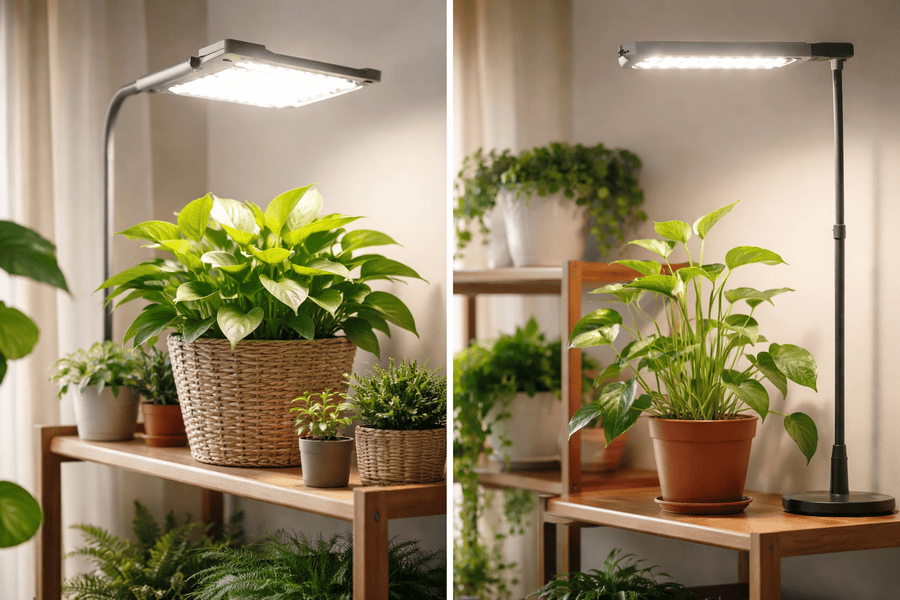
If your plants look “okay” but never quite thrive, common indoor plant lighting mistakes are often the reason.
Lighting problems don’t always show up as dramatic leaf damage — more often, plants just stall, stretch, or slowly decline.
The frustrating part is that many of these mistakes happen even when you’re doing your best.
A room feels bright, a grow light is running, and everything seems fine… but the setup isn’t working the way you think it is.
In this guide, we’ll walk through the most common indoor plant lighting mistakes beginners make, why they cause problems, and easy fixes you can apply without buying new gear or overhauling your setup.
If you want the full beginner foundation that ties lighting type, placement, distance, and timing together, start with Indoor Garden Lighting Made Easy.
🚫 What You’ll Learn (And How to Fix It)
- 💡 The most common lighting mistakes indoor plant owners make
- 🌿 Why these mistakes slow growth or cause uneven plants
- 🔧 Simple fixes you can apply right away
- 📏 When to adjust placement, distance, or light hours
- 🪴 How to avoid changing too many things at once
🚫 Mistake #1: Assuming a “Bright Room” Means Enough Light
One of the most common indoor plant lighting mistakes is assuming that a room that feels bright to you is bright enough for plants. Human eyes adapt quickly to indoor lighting, but plants don’t.
👀 Why your eyes can’t judge plant light
A room can feel sunny while still delivering very little usable light to plant leaves — especially if the plant sits several feet away from a window or off to the side.
This is why plants often struggle in spaces that feel perfectly fine for people.
✅ Easy fix: judge light where the plant actually sits
Instead of judging the room, focus on the plant’s exact location:
- 🌿 Look at how much direct or indirect light hits the leaves
- 🪟 Notice how quickly light fades as you move away from windows
- 💡 Add a grow light if the plant relies mostly on ambient room light
If you’re unsure, it’s usually safer to assume indoor light is weaker than it looks.
🚫 Mistake #2: Leaving Grow Lights On Too Long
Another very common mistake is assuming grow lights should stay on all the time. More light feels like it should mean more growth — but indoors, that logic often backfires.
🌙 Why plants still need darkness
Most indoor plants need a clear day-and-night cycle. Darkness allows plants to rest, regulate growth, and maintain healthy internal processes.
When lights stay on too long, plants may stop growing, fade in color, or look stressed even though they’re getting “plenty” of light.
✅ Easy fix: use a simple light schedule
A basic schedule works well for most homes:
- ⏰ 10–12 hours of light per day for most houseplants
- 🌙 At least 10–12 hours of darkness at night
- ⏲️ Use a timer so the schedule stays consistent
Consistency matters more than squeezing in extra hours.
If you’re unsure how long lights should actually run each day, this guide explains how many hours of light indoor plants need without overcomplicating it.
🚫 Mistake #3: Changing the Light Setup Too Often
When something looks off, it’s tempting to start moving lights, changing schedules, and adjusting placement all at once. This is another lighting mistake that slows progress instead of fixing it.
🔁 Why constant changes confuse plants
Plants don’t respond instantly. It often takes a week or two to see whether a lighting change is helping. When conditions keep shifting, plants never get a chance to settle.
✅ Easy fix: adjust one thing at a time
When troubleshooting lighting:
- 📏 Adjust placement or distance first
- ⏰ Change light hours only if needed
- ⏳ Wait 7–10 days before making another adjustment
Small, steady changes lead to better long-term results.
Next, we’ll look at placement and distance mistakes — including lights that are too far away, too close, or aimed in the wrong direction.
Indoor Plant Troubleshooting Guides
🚫 Mistake #4: Placing Lights Too Far Away
One of the most overlooked common indoor plant lighting mistakes is placing grow lights too far from the plant. The light is technically on — but by the time it reaches the leaves, it’s too weak to do much good.
📏 Why distance weakens light faster than you think
Grow light strength drops quickly as distance increases. Even a few extra inches can dramatically reduce how much usable light reaches your plant.
This is why plants under grow lights often become leggy or lean, even though the light runs for plenty of hours.
✅ Easy fix: reduce distance before increasing hours
If your plant is stretching or growing unevenly:
- ⬇️ Move the light slightly closer (within safe ranges)
- ⏳ Keep the same light schedule for now
- 👀 Watch new growth for improvement over the next week
Adjusting distance is usually more effective — and safer — than immediately adding more light hours.
Distance is often the real issue, and this guide walks through how far grow lights should be from indoor plants using simple, beginner-safe ranges.
🚫 Mistake #5: Placing Lights Too Close
On the flip side, some indoor plant owners place grow lights extremely close, assuming maximum brightness equals faster growth. This often leads to subtle stress instead.
🔥 Signs light may be too intense
Light stress doesn’t always look dramatic. Common early signs include:
- 🌿 Pale or washed-out leaf color
- 🍃 Dry or slightly curled leaf edges
- ⏸️ Growth that slows instead of speeds up
✅ Easy fix: back the light off gradually
If you suspect the light is too close:
- ⬆️ Raise the light by a few inches
- ⏳ Keep hours the same for now
- 👀 Check how new leaves look over the next 7–10 days
Gradual changes prevent shock and help plants recover more smoothly.
🚫 Mistake #6: Poor Light Placement
Even with the right distance and hours, poor placement can undermine your entire lighting setup. Where the light sits matters just as much as how strong it is.
📐 Side lighting vs overhead lighting
Side lighting often causes plants to lean or grow unevenly. Overhead lighting better mimics natural sunlight and encourages upright, balanced growth.
Side lighting can work, but it requires frequent rotation to avoid lopsided plants.
✅ Easy fix: center and level your light
For most indoor setups:
- ⬇️ Place lights directly above the plant canopy
- 🎯 Center the light over the plant, not off to one side
- 🔄 Rotate plants weekly if lighting isn’t perfectly even
Correct placement often fixes uneven growth without changing wattage or hours.
Indoor Plant Lighting Setup Guides
🚫 Mistake #7: Mixing Plants With Very Different Light Needs
Grouping plants randomly under one light is another common indoor plant lighting mistake. While it looks tidy, it can make it impossible to meet every plant’s needs.
🌿 Why one setup can’t suit every plant
Low-light plants and high-light plants respond very differently to the same setup. What’s perfect for one may stress or starve another.
✅ Easy fix: group plants by light category
To simplify lighting:
- 🪴 Group low-light plants together
- 🌿 Keep medium- and high-light plants under stronger or closer lights
- 📏 Adjust distance by group instead of plant-by-plant
This makes it much easier to dial in lighting without constant adjustments.
In the final section, we’ll cover seasonal lighting mistakes, how to troubleshoot step by step, and quick answers to the most common questions beginners ask.
Plants by Lighting Needs
🚫 Mistake #8: Ignoring Seasonal Light Changes
Indoor lighting conditions shift with the seasons, even if your plants never move. One of the most common indoor plant lighting mistakes is assuming summer light and winter light behave the same indoors.
❄️ Why winter light is weaker indoors
During winter, days are shorter and sunlight comes in at a lower angle. This means fewer hours of strong, usable light — especially for plants relying on windows.
Plants often slow down naturally during this time, which can look like a problem when it’s really just a seasonal shift.
✅ Easy fix: adjust hours, not intensity
Instead of moving lights very close or changing fixtures:
- ⏰ Add 1–2 extra hours of light during darker months
- 💡 Keep distance and placement consistent
- 📆 Return to your normal schedule in spring
Small seasonal adjustments usually work better than major setup changes.
🚫 Mistake #9: Overcorrecting Too Quickly
When plants don’t respond immediately, it’s easy to assume something else must be wrong. This leads to overcorrecting — changing distance, hours, and placement all at once.
⏳ Why fast changes cause stress
Plants need time to adapt. Sudden swings in lighting conditions can slow growth even further or cause stress symptoms that weren’t there before.
✅ Easy fix: give changes time to work
After adjusting lighting:
- 📆 Wait 7–14 days before making another change
- 👀 Watch new growth, not old leaves
- 🧠 Keep notes if you’re experimenting
Patience is often the missing ingredient.
🧠 How to Troubleshoot Indoor Plant Lighting Step by Step
If you’re not sure which mistake applies to your situation, use this simple order of operations.
📍 Step 1: Check placement
Make sure the light is centered above the plant and not coming from an awkward angle.
📏 Step 2: Adjust distance
Move the light closer or farther within safe ranges before changing anything else.
⏰ Step 3: Fine-tune hours
Only adjust light duration after placement and distance are dialed in.
If you’ve made a few lighting adjustments but still aren’t sure whether they’re working, this guide shows how to tell if your indoor plants are getting enough light by reading plant signals.
Beginner Indoor Gardening Guides
❓ Frequently Asked Questions
What is the most common indoor plant lighting mistake?
Assuming a room that looks bright to people provides enough light for plants is the most common mistake. Indoor light is usually weaker than it appears.
How do I know if my plant is stressed from light?
Light stress can show up as faded leaves, uneven growth, or stalled development. These signs often appear gradually rather than all at once.
Is it better to increase light hours or move the light closer?
In most cases, adjusting distance is the better first step. Increasing hours is helpful, but distance directly controls light strength.
Can fixing lighting alone improve plant growth?
Yes. Light is often the main limiting factor indoors. Correcting lighting issues can lead to noticeable improvement even without changing water or fertilizer.
How long should I wait to see results after changing lighting?
Most plants need at least 7–14 days to show clear signs of improvement. Look at new growth rather than existing leaves.
🌱 Final Thoughts: Fixing Lighting Without the Stress
Lighting mistakes are incredibly common — even for experienced plant owners. The key is not avoiding mistakes entirely, but recognizing them early and fixing them calmly.
Start with placement, adjust distance next, and fine-tune hours last. When you change one thing at a time and give your plants time to respond, indoor lighting becomes much easier to manage.
Indoor Garden Lighting Made Easy: The Ultimate Beginner Guide
Continue Exploring Indoor Plant Lighting
📚 Further Reading (Research-Backed)
If you’d like to dive deeper into how light affects indoor plants, these university extension resources provide reliable, research-based information on plant lighting, light intensity, duration, and supplemental lighting:
University of Minnesota Extension – Lighting for Indoor Plants
(explains light intensity, duration, and how it affects photosynthesis) :
University of Maryland Extension – Lighting for Indoor Plants
(breaks down the three key aspects of plant lighting: intensity, duration, and quality)
Penn State Extension – Low-Light Houseplants
(good context for how different plants respond to light conditions)
These pages are excellent complements to this guide — especially if you want to understand *why* light matters for plant growth, not just *what* to adjust.

👋 About the Author
Steve is the creator of Indoor Gardening Essentials and a hands‑on indoor gardener with years of experience growing plants in small apartments, tight corners, and low‑light spaces.
He specializes in practical, beginner‑friendly setups—from kitchen herbs and windowsill succulents to self‑watering planters, terrariums, and simple hydroponic systems. Everything he teaches comes from real experimentation, not guesswork.
Steve documents his projects, successes, and occasional failures on his YouTube channel Small Farms Big Ideas , where he tests grow lights, soil mixes, watering routines, and small‑space gardening methods.
His goal is simple: help new indoor gardeners build confidence, avoid common mistakes, and grow healthy plants—no matter how small their space is.